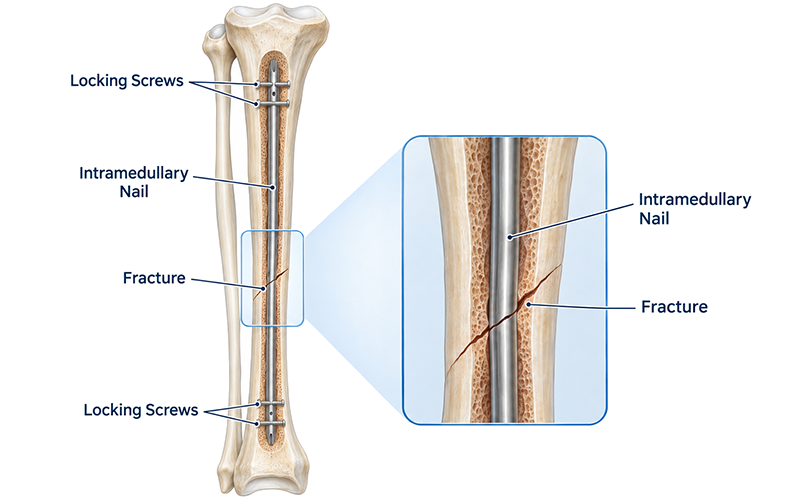
Intramedullary nailing is an operation that stabilizes a broken bone using a specially designed metal rod placed within its central canal. The nail bridges the fracture, helping hold the bone in alignment while healing takes place. It is a form of internal fixation, meaning the supporting implant sits inside the body. [1]
Also called IM nailing, this treatment is commonly associated with fractures of long bones, particularly the thighbone and shinbone. The operation provides support; the body still needs time to repair the fracture. [1]
What Does “Intramedullary” Mean?
“Intramedullary” describes a position within the medullary canal—the marrow-containing space inside a bone. An orthopedic nail is a purpose-built surgical implant, rather than an ordinary nail.
In many systems, locking screws pass through the bone and nail to help control rotation and shortening. The nail and screws work together to maintain the planned position during healing. [1]
Which Fractures Can Be Treated With an Intramedullary Nail?
Femoral and tibial shaft fractures are common examples. The shaft is the long middle portion of the bone. For many adult femoral shaft fractures, intramedullary nailing is a widely used surgical treatment. [2]
However, a nail is not suitable for every fracture. Fracture location, alignment, joint involvement, soft-tissue damage and the patient’s overall condition influence the plan. Some injuries require a different fixation method or staged treatment. [2,3]
This article focuses mainly on adult long-bone fracture care. Children have growing bones and growth plates, so adult nailing techniques and recovery advice should not be applied automatically to pediatric fractures. [3]
How Does Intramedullary Nailing Work?
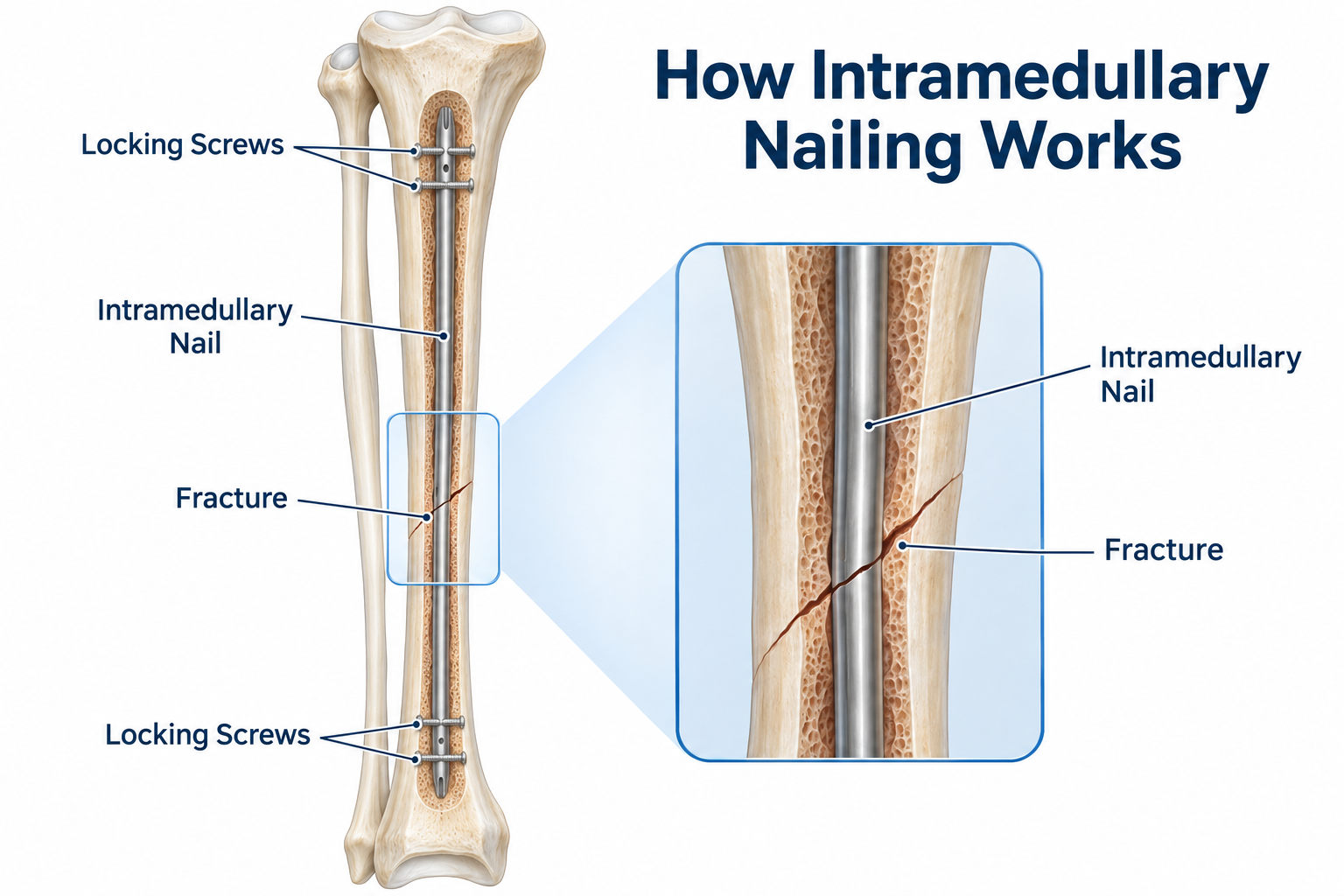
The aim is to restore appropriate bone alignment and provide sufficient stability for healing. Treatment involves more than inserting a rod: the surgeon also evaluates the bone’s length, rotation and surrounding tissues. [4]
At a general level, the operation involves:
- Aligning the fracture: Bringing the main bone fragments into the intended position.
- Preparing access: Creating an entry into the medullary canal.
- Placing the nail: Passing a suitably sized implant across the fracture, with imaging used to check its position.
- Securing fixation: Adding locking screws where required by the construct.
- Checking the result: Confirming alignment and implant position before completing the operation. [4]
Some procedures involve reaming, which enlarges the canal to accommodate the selected nail. The exact approach depends on the bone, fracture and implant system. This overview explains the principle and is not a surgical technique guide. [4]
Intramedullary Nail vs. Plate and Screws
Both methods are forms of internal fracture fixation, but they support the bone in different locations.
| Feature |
Intramedullary nail |
Plate and screws |
| Implant position |
Within the bone’s central canal |
Along the bone’s outer surface |
| General role |
Bridges and stabilizes selected fractures from inside |
Holds selected fragments in alignment from outside the canal |
| Selection |
Depends on fracture pattern and anatomy |
Depends on fracture pattern and anatomy |
| Healing |
Requires biological bone healing |
Requires biological bone healing |
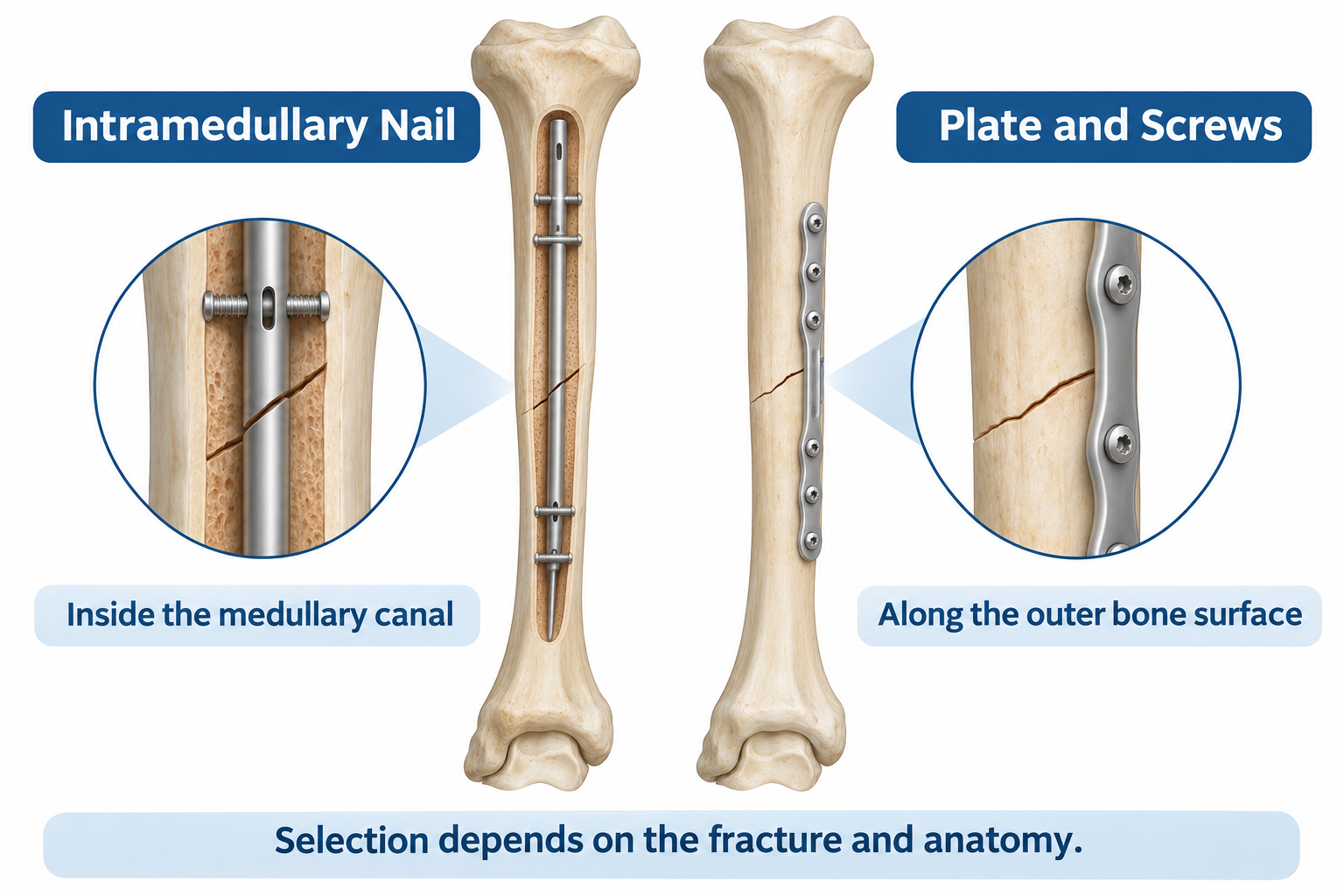
Neither method is universally better. For example, fractures extending into a joint may require fixation that addresses the joint surface, and plating may be appropriate in some of these situations. [1,2,3]
Why Might a Surgeon Recommend Nailing?
For suitable fractures, a nail provides strong internal support across the injured region. This can form part of a plan to restore movement and function. It does not mean that unrestricted activity is immediately safe. [2]
The choice should be explained in relation to the individual injury. Useful questions include why nailing is preferred, whether another operation may be needed, and what restrictions are expected afterward.
What Happens After Intramedullary Nail Surgery?
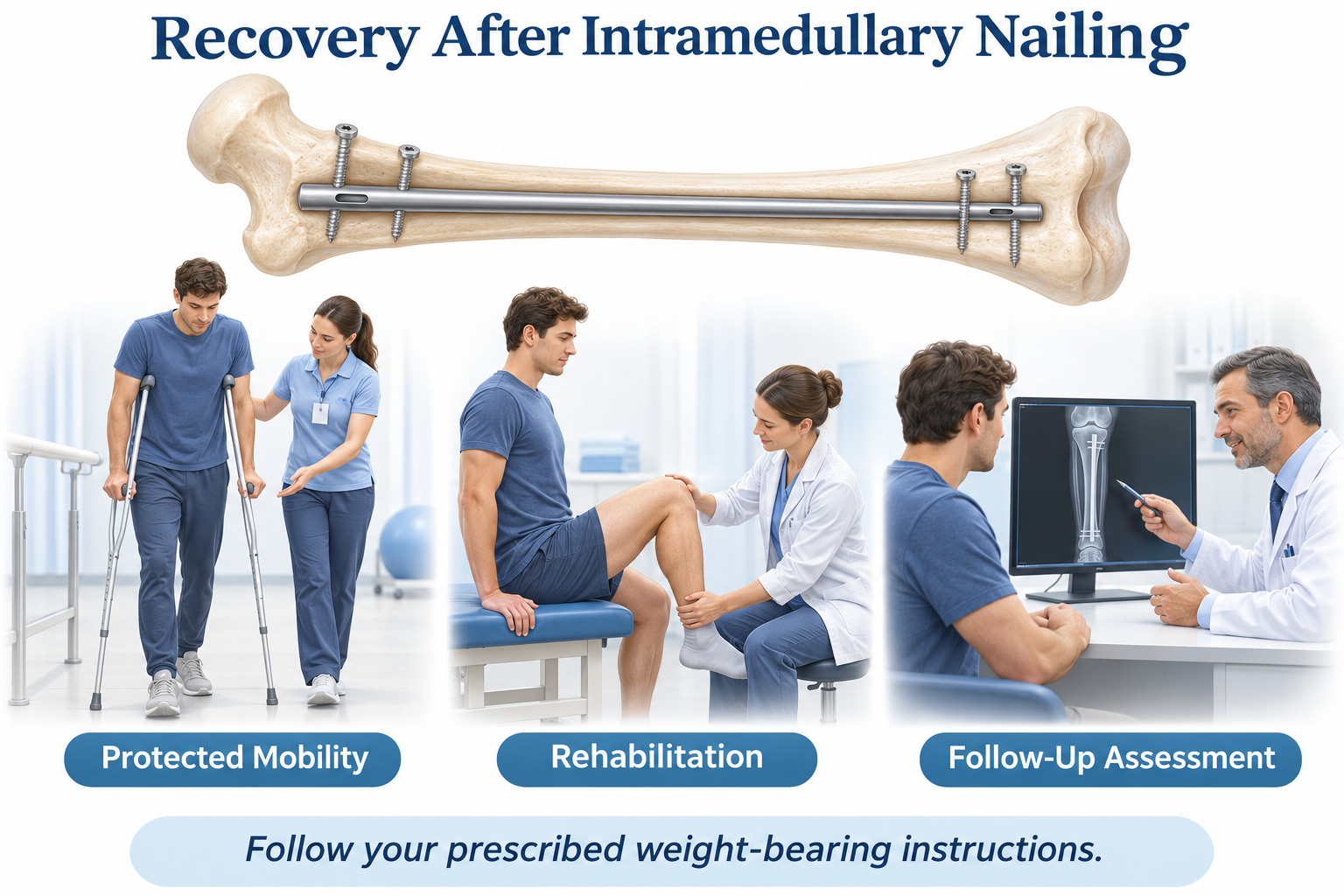
Early care includes pain management, wound observation and assistance with movement. For leg fractures, a physiotherapist may teach the patient to use crutches or a walking frame and manage stairs safely. [5]
The discharge plan should clearly state:
- How much weight may be placed through the injured leg.
- Which walking aids are needed.
- How to care for the wound.
- Which exercises are permitted.
- When follow-up appointments are scheduled.
- Who to contact if problems develop.
Ask for clarification before leaving hospital if these instructions are unclear.
Can You Walk After Intramedullary Nailing?
Sometimes early weight-bearing is permitted; other fractures require a period of protection. The presence of a nail alone does not determine whether walking without support is safe. [5,6]
“Weight-bearing” describes how much body weight may pass through the affected leg. Follow the surgeon’s prescribed level and the physiotherapist’s instructions. Another patient’s walking schedule may not apply to your fracture. [5]
How Long Does Fracture Healing Take?
Healing usually takes months. As broad examples, AAOS describes approximately three to six months for many femoral shaft fractures and four to six months for many tibial shaft fractures. Open fractures, multiple fragments and tobacco use can be associated with longer healing. These ranges are not individual recovery deadlines. [2,3]
Bone union and functional recovery are different milestones. Follow-up considers both imaging and function; improving comfort alone does not establish that unrestricted activity is appropriate. [6]
Rehabilitation and Returning to Daily Life
Rehabilitation helps patients recover movement and mobility within the limits of their injury. The plan should account for the fixation, soft tissues and other injuries. Exercises and walking aids may change as recovery progresses. [5]
Return to work, driving and sport should be discussed separately. A seated job and physically demanding work have different requirements. Ask the treating team which milestones must be met rather than relying on a single online recovery timetable.
What Are the Possible Risks?
Potential problems include infection, bleeding, persistent pain, loss of alignment, delayed healing or nonunion. Implants can also cause irritation or require further surgery. Knee pain is a recognized concern after tibial nailing. [6]
A further serious complication after some limb injuries is acute compartment syndrome, in which pressure rises within a muscle compartment and threatens circulation. Severe or rapidly worsening pain requires urgent assessment; do not wait for numbness or paralysis to appear. [7]
Seek prompt advice for wound drainage, increasing redness or new sensory changes. Sudden breathing difficulty or chest pain requires emergency assessment. Follow the hospital’s instructions for your injury. [5,8]
Does an Intramedullary Nail Need to Be Removed?
Not routinely. Nails and screws may remain after healing. Removal may be considered for problems such as infection or symptomatic irritation, but it is a separate decision with its own risks. [1,6]
Do not assume removal is required at a fixed time. The surgeon must consider healing and whether another operation is likely to help. [6]
Frequently Asked Questions
Is intramedullary nailing the same as joint replacement?
No. Nailing stabilizes a fracture within a bone. Joint replacement substitutes components of a joint. [1]
Does the nail replace the broken bone?
No. It supports the fracture while the bone heals. [1]
Will everyone need a cast afterward?
No. Additional support depends on the injury and treatment plan. Ask what protection is required in your case. [6]
Can I stop using crutches when the pain improves?
Only when permitted by your care team. Pain relief does not override prescribed weight-bearing restrictions. [5]
Trauma Orthopedic Solutions at Davin Med
Intramedullary nailing is one part of modern orthopedic trauma care. Davin Med’s trauma portfolio brings together fracture fixation implants and surgical instrumentation for professional healthcare buyers and medical device distributors.
Explore Davin Med Intramedullary Nail Systems for an overview of this product category. Professional buyers can request current product information, supporting documentation and supply details. Treatment decisions and implant selection remain the responsibility of qualified healthcare professionals.
This article provides general education and does not replace individual medical advice. Follow your surgeon’s and rehabilitation team’s instructions for your fracture and fixation.
References
- AAOS OrthoInfo — Internal Fixation for Fractures
- AAOS OrthoInfo — Femur Shaft Fractures
- AAOS OrthoInfo — Tibial Shaft Fractures
- AO Surgery Reference — Basic Principles of Intramedullary Nailing
- King’s College Hospital NHS — Intramedullary Nail Surgery for Tibia Fractures
- Northern Care Alliance NHS — Tibial Intramedullary Nailing
- AAOS OrthoInfo — Compartment Syndrome
- NHS — Broken Leg