Broken bones in dogs and cats are treated by controlling pain, assessing other injuries and providing enough stability for the fracture to heal. Depending on the injury, treatment may involve a cast or splint, surgical implants, or an external fixation frame. There is no single method suitable for every pet. [1,2]
For owners, the most important first step is prompt veterinary care. This guide focuses mainly on limb fractures; fractures of the jaw, pelvis or spine may require different treatment plans.
What Are the Signs of a Broken Bone?
A pet with a fracture may limp, avoid using a limb, show pain or develop swelling. Some fractures cause an obvious change in limb position, while others are less apparent. [2]
These signs are not specific to fractures. A sprain, joint injury or another painful condition can look similar. Do not manipulate the limb to test whether it is broken; veterinary examination and imaging are needed.
What Should You Do if You Suspect a Fracture?
Call a veterinarian immediately and explain what happened. Keep your pet as still as possible and ask how to move and transport them safely. Do not encourage a pet with a suspected broken leg to walk. [3]
Avoid straightening the limb or applying a homemade splint. Cover an open wound gently with a clean cloth while obtaining veterinary advice, without pushing exposed bone back into place. Do not give medication unless the veterinarian instructs you to do so. [1,3]
After a road accident or major fall, breathing difficulty, collapse or pale gums are urgent concerns. A painful leg may be only one part of the injury. [3,4]
How Do Vets Diagnose Fractures?
The veterinary team first checks the whole animal, particularly after significant trauma. Chest, abdominal or other injuries may need attention before definitive fracture repair. Treating those problems first does not mean the broken bone is being ignored. [4]
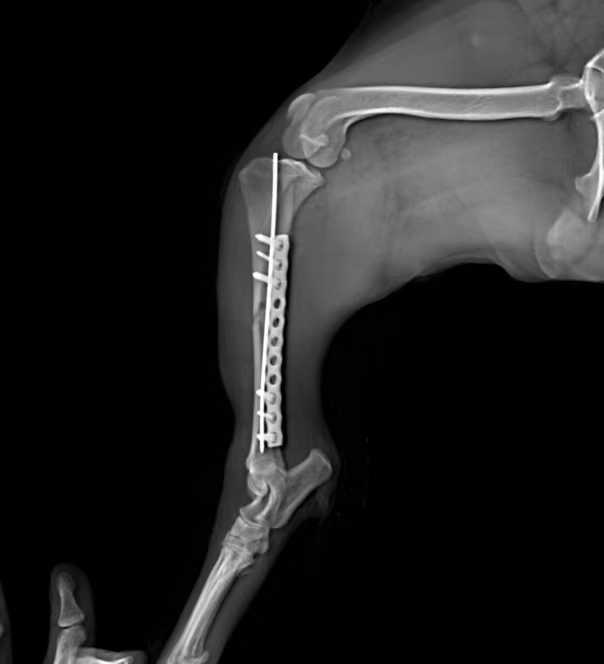
X-rays help identify the fracture and guide planning. CT may be useful for selected complex injuries or patients with multiple injuries. Pain relief and sedation may be needed to obtain images safely. [4,5]
Ask the veterinarian to explain which bone is affected, whether the fragments are displaced and whether a joint is involved.
Why Does the Type of Fracture Matter?
Fractures differ in location, shape, stability and damage to surrounding tissues. An open fracture communicates with the outside environment through a wound; a closed fracture does not. A comminuted fracture has multiple fragments. [2]
Joint and growth-plate injuries deserve particular attention. In puppies and kittens, damage to a growth plate can affect later limb development. Fractures involving a joint surface may require precise reconstruction and longer-term monitoring for arthritis. [6]
Age, general health, activity level and the practicalities of home care also influence treatment selection. [5]
What Treatments Are Available?
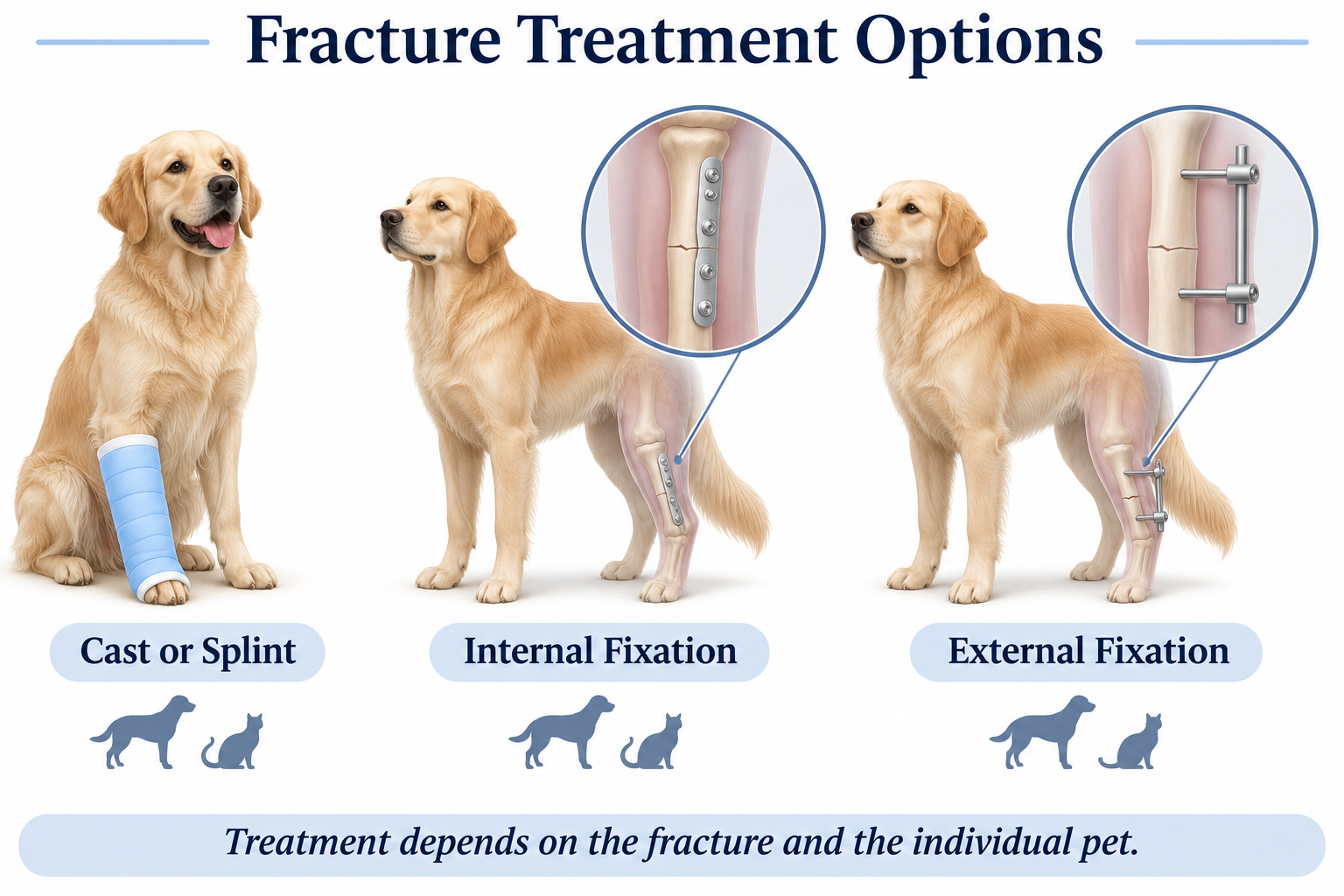
Casts and splints
A cast or splint supports the limb from outside. It can be appropriate for selected fractures that can be maintained in acceptable alignment. It is not a universal substitute for surgery. [5]
Fractures high in the limb, such as many thighbone or upper-arm fractures, are difficult to stabilize adequately with a cast. Bandage care, repeated checks and possible complications must also be considered. Nonsurgical care is not automatically the simplest option. [5]
Internal fixation
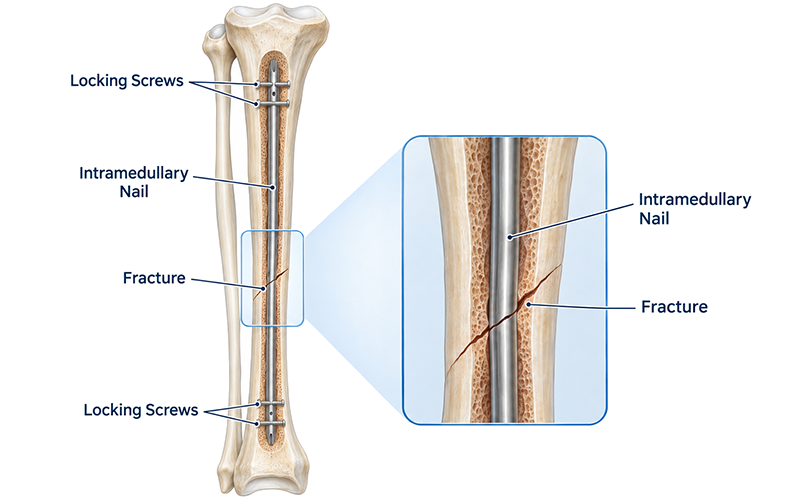
Internal fixation uses implants within the body to stabilize the bone. Options include plates and screws, pins, wires and interlocking nails. The surgeon selects a construct for the fracture rather than using the same implant for every injury. [1,2]
External skeletal fixation
An external fixator uses pins that connect the bone to a supporting frame outside the skin. It differs from a cast because it is surgically attached to the bone. [1]
Comparing the approaches
| Treatment |
Where support is provided |
Key consideration |
| Cast or splint |
Outside the limb |
Whether it can maintain sufficient stability and alignment |
| Internal fixation |
Inside the body |
Fracture pattern, anatomy and implant configuration |
| External fixation |
Frame outside the skin, connected to bone |
Suitability for the injury and required frame care |
The best option balances mechanical stability, tissue healing and the individual pet’s needs. [1,5]
What Does Fracture Surgery Aim to Achieve?
The goal is to restore useful alignment and stabilize the injured bone while healing occurs. Surgery may be straightforward or complex depending on the fracture. Implants provide support; they do not replace the biological healing process. [7]
Open fractures also require attention to contamination and damaged tissues. The team may recommend staged care rather than one immediate definitive operation. [1,2]
Before treatment, ask what outcome is expected, which alternatives are reasonable and whether specialist referral would be helpful.
How Long Do Broken Bones Take to Heal?
Recovery usually takes weeks to months. There is no fixed timetable that applies to every broken leg in a dog or cat. Age, fracture complexity, tissue damage and stability all affect healing. [1,5]
The follow-up schedule matters more than a generic date. Clinical assessment and repeat imaging help determine whether activity can increase. A pet using the limb more confidently does not necessarily have a fully healed fracture. [2,7]
Caring for Your Pet During Recovery
Control activity
Follow the prescribed confinement and exercise plan. Prevent running, jumping and rough play. Dogs may need controlled lead outings; cats may need an indoor recovery area that prevents climbing and jumping. Ask the clinic how to arrange the space for your particular pet. [7]
Monitor bandages and casts
Watch for slipping, wetness, chewing or damaged material. Swelling of visible toes also warrants prompt advice. Contact the clinic if anything changes; do not simply add another tight layer or wait until the next appointment. [1]
Follow medication and wound instructions
Keep a written medication schedule and use only medicines authorized for that animal. Ask what to do if a dose is missed or your pet seems uncomfortable. Protect the wound as directed and request advice if your pet interferes with it.
Use rehabilitation at the right time
Physiotherapy or hydrotherapy may be recommended, but the programme should match the stage of healing. Do not begin exercises or swimming without approval. [7]
What Complications Should Owners Know About?
Possible problems include infection, poor bone healing and implant breakage. Fractures involving joints can lead to arthritis. A good repair still requires appropriate aftercare and review. [7]
Contact the veterinary team promptly for increasing pain, wound drainage, a damaged bandage or sudden deterioration in limb use. Breathing difficulty, collapse or uncontrolled bleeding requires emergency veterinary care.
Will Plates, Screws or Pins Need to Be Removed?
Not all implants need removal. Internal fixation may remain after healing unless complications such as infection or tissue irritation develop. External frames and some other devices have a planned removal process. Ask which applies to your pet’s treatment. [2]
Questions to Ask Your Veterinarian
- Why is this treatment recommended for this fracture?
- What restrictions will my pet need at home?
- When are bandage checks and repeat X-rays due?
- Which signs should prompt an urgent call?
- Does the estimate include follow-up care and possible implant removal?
Frequently Asked Questions
Can a cat’s broken leg heal without surgery?
Some selected fractures can be treated without surgery. The decision depends on stability, alignment and the patient, not simply on whether the animal is a cat. [5]
Does every fracture need a cast?
No. Some fractures need surgical stabilization, and an additional cast is not always required. [1,5]
Is walking normally proof of healing?
No. Follow-up assessment is needed before unrestricted activity resumes. [2,7]
Can most pets regain good limb function?
Many do well with suitable treatment and aftercare, but the injury’s severity and joint involvement affect the outlook. An individual result cannot be guaranteed. [4,7]
Veterinary Orthopedic Solutions at Davin Med
Fracture care is a major area of veterinary orthopedics. Davin Med’s veterinary portfolio brings together orthopedic implants, surgical instruments and related equipment for veterinary professionals and distributors.
Explore Davin Med Veterinary Orthopedic Products for an overview. Professional buyers can request current specifications, documentation and supply information. Pet owners should discuss treatment and implant selection directly with their veterinarian.
This article provides general education and does not replace veterinary advice. A suspected fracture requires prompt veterinary assessment. Follow your veterinary team’s instructions for your pet’s treatment and recovery.
References
- American College of Veterinary Surgeons — Fractured Limbs
- Merck Veterinary Manual — Bone Fractures in Dogs and Cats
- PDSA — First Aid for Broken Bones
- Cornell University — Orthopedic Surgery: Medical Conditions
- MSPCA-Angell — Decision-Making With Fracture Management
- Merck Veterinary Manual — Joint Trauma in Dogs and Cats
- North Downs Specialist Referrals — Fracture Treatment: An Ov