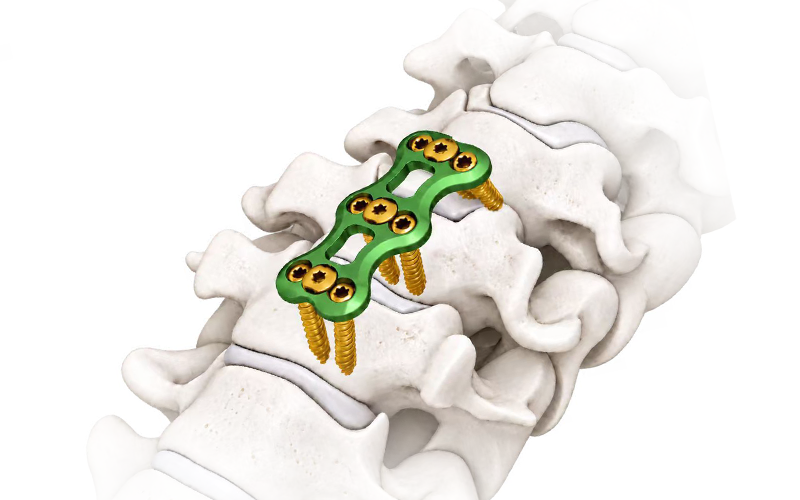
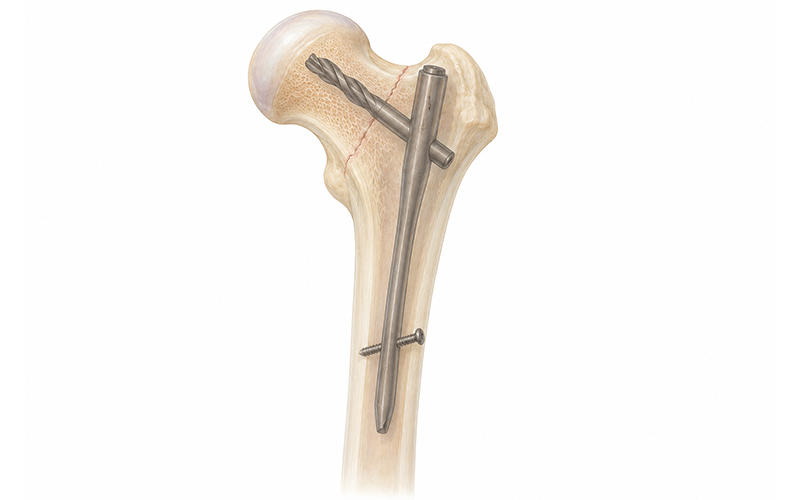
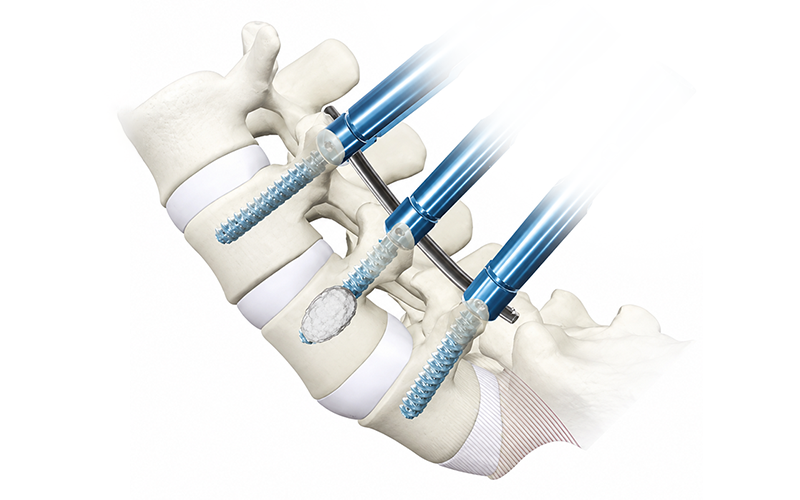
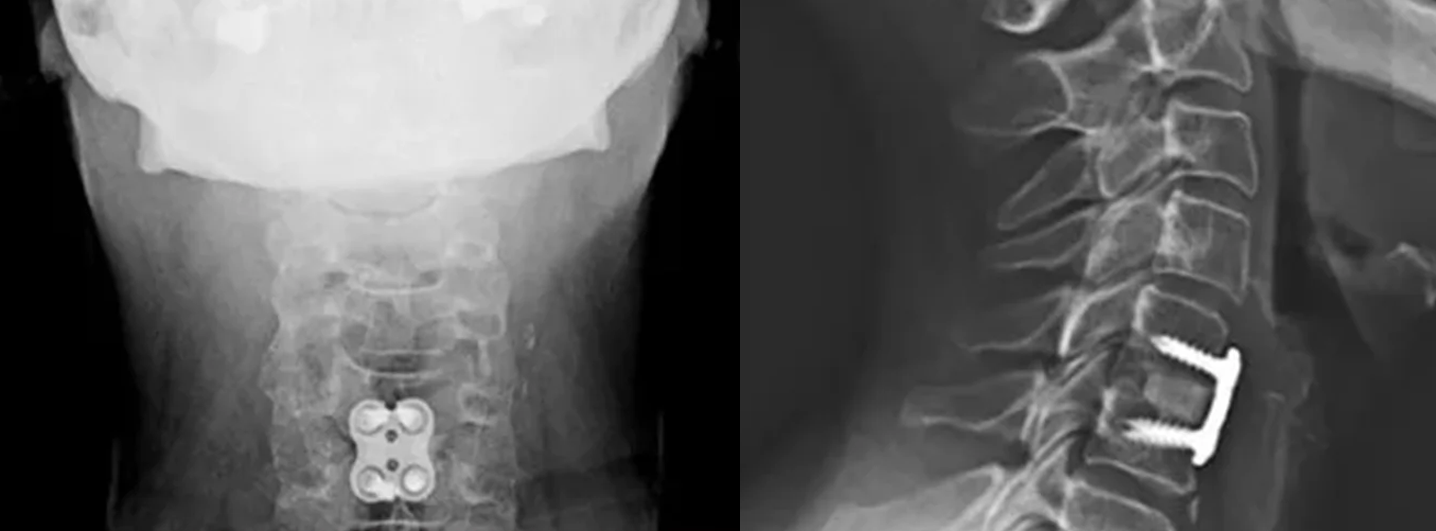
A cervical plate helps stabilize the bones in the neck while a spinal fusion heals. Attached to the front of the vertebrae with screws, it provides internal support and helps maintain alignment across the treated area.
Cervical plates may be used during anterior cervical discectomy and fusion, commonly called ACDF. Understanding how the plate works—and how it differs from a cage or bone graft—can help patients understand their surgery and recovery.
What Is a Cervical Plate?
A cervical plate is an orthopedic implant positioned along the front of the cervical spine. Bone screws secure it to the vertebrae above and below the treated disc space.
The plate and screws form a fixation system that limits movement at the operated segment while bone healing takes place. The plate provides mechanical stability; the fusion develops as bone grows between the vertebrae.
Why Is a Cervical Plate Used During ACDF?
During ACDF surgery, the surgeon removes a damaged disc and, when necessary, bone spurs that are pressing on a nerve or the spinal cord.
A bone graft or interbody cage then occupies the space left by the removed disc. A cervical plate may be added to support the reconstructed area.
Its main purposes include:
- Providing additional stability across the treated spinal segment.
- Helping maintain the alignment established during surgery.
- Limiting movement while the bone graft incorporates and fusion develops.
A cervical plate does not guarantee a successful fusion. Bone health, the condition being treated, and other patient factors also influence healing.
Cervical Plate vs. Cage: What Is the Difference?
A cervical plate and an interbody cage occupy different positions and perform different functions.
| Component |
Position |
Main Function |
| Cervical plate |
Along the front of the vertebrae |
Provides additional stability across the treated segment |
| Bone screws |
Through the plate into the vertebrae |
Attach the plate to bone |
| Interbody cage or spacer |
Between the vertebral bodies after disc removal |
Provides structural support in the disc space |
| Bone graft |
Within or around the fusion space, depending on the technique |
Supports the formation of a bony connection |
These components may be used together. The cage supports the space between the vertebrae, while the plate stabilizes the area from the front.
Does a Cervical Plate Relieve Pressure on Nerves?
The plate’s primary role is stabilization.
Decompression relieves nerve pressure by removing the disc material or bone that is crowding a nerve or the spinal cord. The plate supports the reconstructed spinal segment afterward.
Although decompression and fixation may occur during the same operation, they serve different purposes. The plate itself does not remove the tissue causing nerve compression.
Does Every Neck Fusion Need a Plate?
No. Some cervical fusion procedures use a separate plate, while others use a different implant arrangement.
The choice depends on the condition being treated, the number of spinal levels involved, bone quality, and the planned surgical approach.
A useful question before surgery is: “Will my operation use a separate plate, and what role will it play in my treatment?”
Does Having a Plate Mean the Neck Is Already Fused?
No. The plate is secured during surgery, but fusion requires bone to grow across the treated space.
Symptoms may improve before the fusion is complete. Feeling better does not necessarily mean that the neck is ready for heavy lifting, strenuous exercise, or unrestricted activity.
Follow-up examinations and imaging help the surgical team assess healing and decide when activity can increase.
What Should Patients Expect During Recovery?
Recovery after cervical fusion varies with the operation and the individual patient.
Walking and a gradual increase in activity are commonly encouraged. Heavy lifting and strenuous exercise may be restricted during early recovery. Some patients are prescribed a neck collar, while others are not.
Follow the surgical team’s instructions about activity, wound care, collar use, and follow-up visits. Recovery advice from another patient may not apply to your procedure.
Can a Cervical Plate Cause Swallowing Difficulty?
Some patients experience swallowing discomfort or a hoarse voice after surgery through the front of the neck.
These symptoms can have several causes, including swelling and temporary effects on nearby tissues. The plate’s position or profile can also contribute in some cases. Swallowing difficulty does not automatically mean that the plate has moved.
Contact the care team promptly for severe or worsening swallowing problems, particularly if you cough when eating or drinking. Breathing difficulty requires emergency assessment.
Frequently Asked Questions
Is a cervical plate the same as an artificial disc?
No. A cervical plate is a fixation device that may support fusion. An artificial disc is used in a different procedure intended to preserve movement at the treated level in suitable patients.
Does the plate replace the need for bone healing?
No. The plate provides support while fusion develops. A lasting bony connection still depends on the healing process.
Does every pinched nerve in the neck require surgery?
No. Many cases improve with nonsurgical treatment. Surgery may be considered when symptoms persist or worsen, depending on the examination and imaging findings.
When can patients return to normal activities?
There is no single schedule for everyone. The surgical team considers the procedure, symptoms, healing progress, and the demands of each activity.
Cervical Fixation Solutions From Davin Med
Cervical plates are one part of a broader spinal fixation and fusion system. Understanding their relationship with screws, cages, and bone graft helps explain how these components support different stages of treatment.
For orthopedic professionals and distributors, explore the Davin Med Spine System category for spinal implants and supporting instruments.
This article provides general education and does not replace advice from a qualified spine specialist.