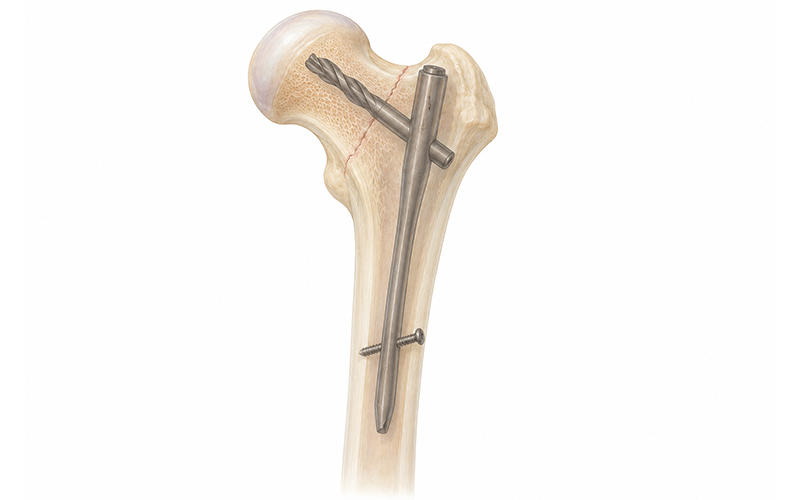
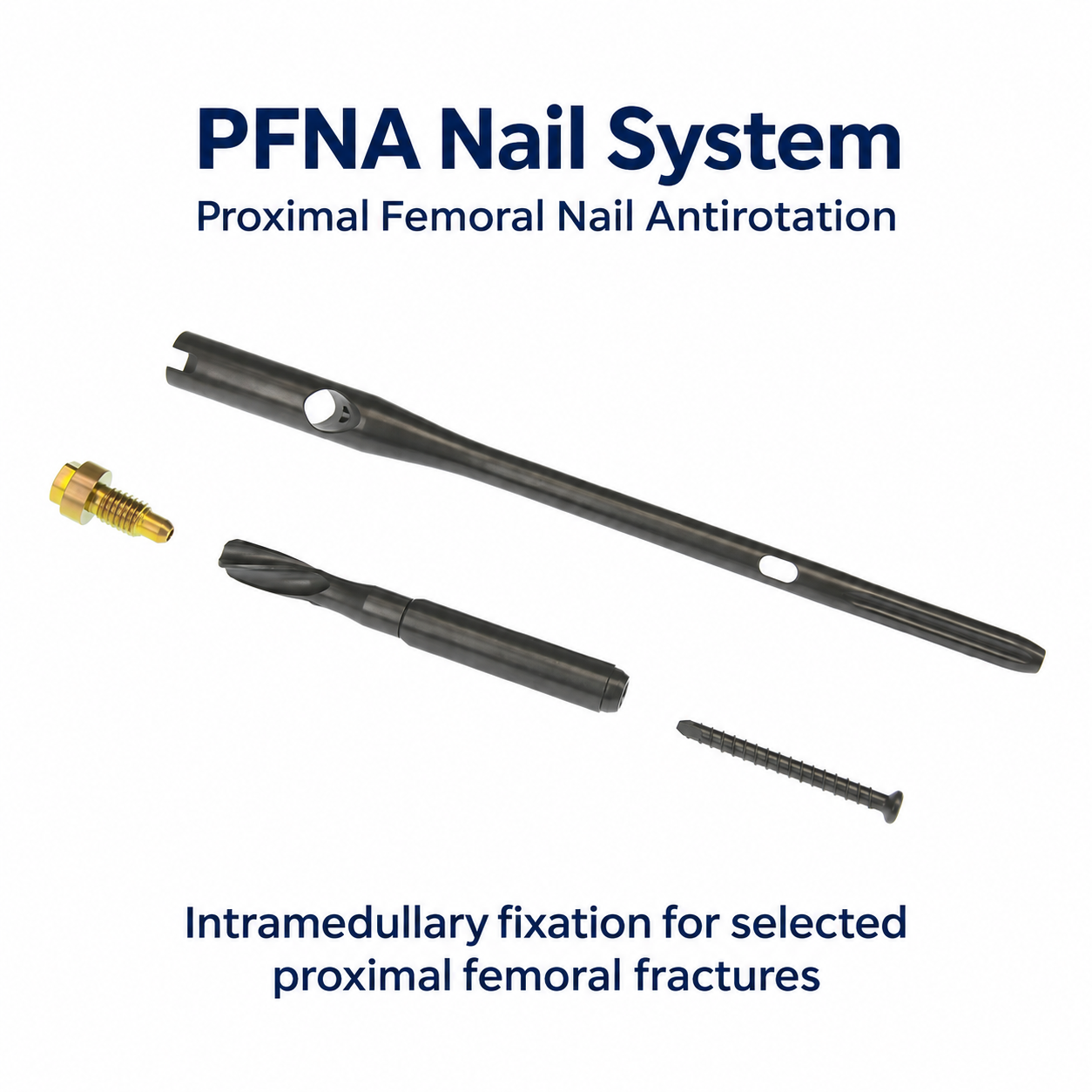
A PFNA nail is an implant used to stabilize certain fractures near the top of the thighbone, or femur. The name stands for Proximal Femoral Nail Antirotation. Its main components include a nail inside the bone and a helical blade that extends into the femoral head—the ball of the hip joint. Together, they help hold the broken bone in position while it heals.
Which Hip Fractures Can a PFNA Nail Treat?
“Hip fracture” describes several injuries around the upper femur. PFNA fixation is primarily associated with fractures in the trochanteric region, near the bony prominences below the femoral neck. These include selected pertrochanteric and intertrochanteric fractures.
A fracture in this region presents a different problem from a fracture through the femoral neck. Depending on its location and pattern, a hip fracture may be treated with a nail, a screw-and-plate system, or hip replacement. PFNA is therefore one fixation option, rather than a treatment for every hip fracture.
How Does a PFNA Nail Work?
The implant connects the upper part of the femur to its shaft, helping maintain the position of the fracture fragments.
| Component |
Main role |
| Intramedullary nail |
Sits inside the femoral canal and provides internal support across the fracture. |
| Helical blade |
Extends through the nail into the femoral head and neck fragment, helping resist rotation. |
| Distal locking screw or screws |
Secure the lower portion of the nail to the femoral shaft and help control movement. |
The precise configuration varies with the implant and fracture.
What Does the Helical Blade Do?
The blade has a spiral shape. During insertion, it compacts the spongy bone around it, creating a fit that helps resist rotation of the femoral head and neck fragment.
This explains the term “antirotation.” It describes a function of the fixation system; it does not mean that implant movement or fixation failure is impossible.
Is PFNA Surgery the Same as Hip Replacement?
No. PFNA fixation supports the patient’s existing bone while the fracture heals. Hip replacement substitutes artificial components for part or all of the joint.
The choice depends on where the bone broke, the fracture pattern, and the patient’s condition. A surgeon may recommend different operations for two people who both describe their injury as a broken hip.
What Happens During Recovery?
Recovery involves more than waiting for the fracture to unite. Patients also work on standing, walking, strength, and everyday tasks.
When medically safe, rehabilitation often begins soon after hip fracture surgery. A physiotherapist helps with walking aids and movement, while the surgical team specifies how much weight the patient can put through the operated leg. Having a nail in place does not automatically mean unrestricted weight-bearing is appropriate.
Follow-up appointments allow the team to check the wound, review mobility, and use X-rays to monitor healing. Recovery varies with the injury, overall health, and level of independence before the fracture.
Why Is Bone Health Important After a Hip Fracture?
A fracture after a low-energy fall may signal weakened bone. Alongside rehabilitation, the care team may arrange a bone-health assessment and discuss ways to reduce future fracture risk.
Poor bone quality can also affect how securely fixation holds. Addressing osteoporosis and fall risk is therefore an important part of care after a fragility fracture.
Frequently Asked Questions
Is a PFNA nail placed inside the bone?
Yes. The main nail sits in the femoral canal. Its blade extends into the femoral head and neck, while distal screws secure it to the shaft.
Is PFNA the same as every other hip nail?
No. PFNA is a particular nail design. Other proximal femoral nail systems may use a lag screw, a blade, or a different combination of components. System names alone do not establish that their implants or instruments are interchangeable.
When can a patient walk after PFNA surgery?
Assisted movement may begin early, but the permitted amount of weight-bearing comes from the treating team. Ask for clear instructions about walking aids, stairs, and progression of activity.
For orthopedic professionals and distributors exploring fixation systems, visit the Davin Med Intramedullary Nail Systems category for implants and supporting instrument sets. Specific indications and configurations should be checked against the documentation for the proposed system.
This article provides general education. An orthopedic surgeon determines the appropriate treatment and rehabilitation plan for each patient.