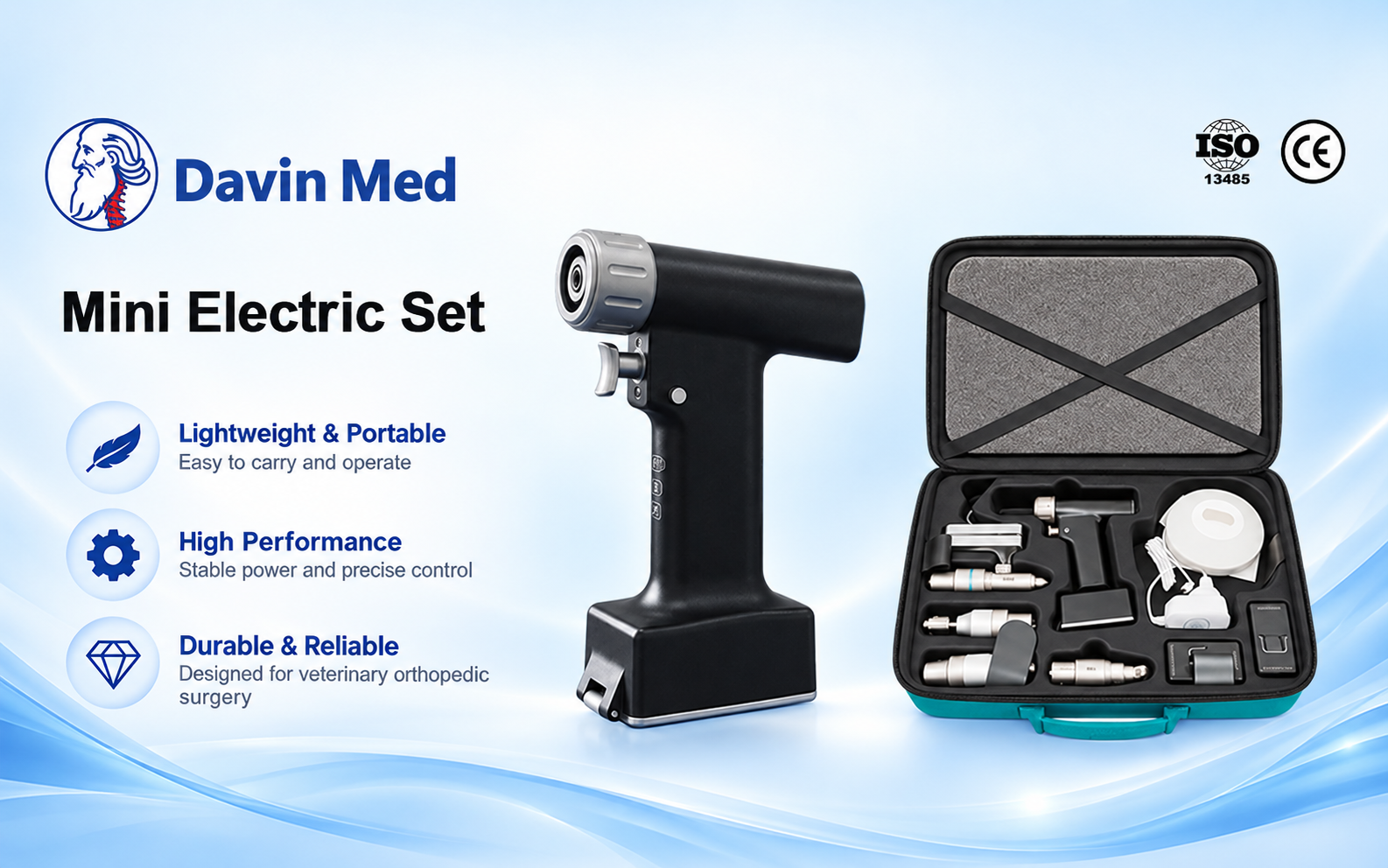
A veterinary PGR complete instrument set is used to support patellar groove replacement procedures, providing the system-specific tools needed for trial assessment, positioning, bone preparation and implant placement or fixation, as specified by the manufacturer. The exact instruments and their functions depend on the selected system.
PGR stands for patellar groove replacement. To understand the instrument set, it helps to separate three things: the joint problem being assessed, the implant intended to address it and the tools used during the procedure.
The Joint Structure Behind the Name
The patella, or kneecap, moves within a groove at the lower end of the femur. In dogs, this area forms part of the stifle, commonly called the knee.
Canine patellar luxation means that the kneecap moves out of its normal groove. Some affected joints also develop damage to the patellofemoral joint surfaces. The presence of patellar luxation alone does not mean that groove replacement is needed.
Patellar groove replacement has been described for selected dogs with patellar luxation and severe femoropatellar osteoarthritis. A veterinary orthopedic assessment determines whether it is appropriate and whether other problems also require treatment.[1]
A PGR instrument set supports the selected procedure. It does not replace diagnosis, imaging, surgical planning or procedure-specific training.
What Does the Instrument Set Actually Do?
A tray of specialized instruments is easier to understand when grouped by purpose rather than by appearance. Across a patellar groove replacement workflow, the relevant tasks may include assessing size and fit, maintaining a planned position, preparing specified features and handling compatible components.
These are functional categories, not a universal packing list or a surgical sequence.
| Instrument category | General purpose | What needs confirmation |
|---|
| Trial or sizing components | Help assess a proposed size and fit | Size references and relationship to the intended implant |
| Positioning components | Support the positioning tasks defined for the system | Compatible references and intended function |
| Bone-preparation tools | Perform the preparation specified for that system | Correct tool, size and operating instructions |
| Drill bits and limiting components | Support documented drilling or limiting functions | Compatible guide, power interface and restrictions |
| Insertion or fixation instruments | Handle, seat or secure specified components where applicable | Matching implant and instrument interfaces |
| Instrument box or tray | Organize and identify instruments | Contents, processing suitability and storage requirements |
A component described as a positioning plate, for example, should not automatically be treated as an implant. Its classification and use must come from the product documentation.
What Is Listed in a Davin Med PGR Instrument Range?
Davin Med’s veterinary orthopedic catalogue lists several PGR-related instrument groups:
- Trial components, labelled “Model Test” in the catalogue.
- Punches in a range of size references.
- A driver-related hammer handle.
- PGR positioning base plates.
- Positioning and limiting Kirschner wires.
- Drill bits described with limiting functions.
- A PGR instrument box.
This list helps identify the types of components to discuss with the supplier. It does not establish the contents of every quotation or provide instructions for using each instrument.
The role of a particular punch, positioning plate or limiting drill bit should be checked against the corresponding technical documentation. A catalogue name alone is not sufficient to infer the surgical action.
For an overview of the available product, visit the Davin Med PGR Complete Instrument Set page, then request the current component list for the configuration you need.
Instruments and Implants Have Different Roles
A PGR instrument set contains tools used during the procedure. A PGR implant set contains components intended to remain in the patient, according to the selected implant system.
They may be offered together, but the terms are not interchangeable.
| Supply item | How to understand it |
|---|
| Instrument set | Tools used to perform specified tasks |
| Implant components | Components intended for implantation |
| Trial components | Assessment tools; not automatically final implants |
| Instrument box | Organization and storage equipment |
| Combined package | Instruments and implants expressly listed together |
This distinction matters when comparing suppliers. Two quotations carrying similar product names may cover different items.
For a clear comparison, ask for separate identification of instruments, implant components, quantities and size coverage.
What Does “Complete” Mean?
“Complete” should describe the scope of a defined instrument configuration. It does not automatically mean every implant size, every replacement tool or all equipment needed in the operating room.
A complete veterinary PGR instrument set might still require separately supplied implants, general surgical instruments or compatible powered equipment. The manufacturer’s instructions and the agreed packing list determine what is required.
Three questions make the word more useful:
- Complete for which implant system and size range?
- Which instruments and quantities are included?
- What must be ordered separately?
Those answers are more informative than the number of instruments visible in a photograph.
Why System Compatibility Matters
Matching labels and similar shapes do not prove that two components work together.
Trial references must correspond to the intended implant sizes. Positioning tools must suit the selected system. Drill bits, guides and driver interfaces must be confirmed as compatible where those components are required.
This applies both within a supplier’s product range and when considering instruments from different manufacturers. Purchasing a veterinary orthopedic instrument set does not establish compatibility with every patellar groove replacement implant.
If the clinic plans to reuse existing equipment, provide its exact references when requesting confirmation.
Where PGR Fits Among Canine Knee Procedures
Several procedures address problems around the canine stifle, but their names refer to different tasks.
Patellar groove replacement concerns the groove surface involved in patellar movement. Trochleoplasty changes the existing groove. TPLO addresses a different aspect of stifle mechanics and should not be treated as another name for PGR.
Likewise, PGR is not a total knee replacement, and a PGR tray is not automatically a general-purpose kit for fracture fixation, meniscal repair or cruciate ligament reconstruction.
These distinctions help veterinary buyers choose the correct product category without implying that one approach is suitable for every dog with a knee problem.
Preparing a PGR Set for Clinical Use
Before a new set is put into service, the team needs to know what each component is, how it relates to the selected system and how it should be processed.
Useful checks include:
- Reconcile the supplied instruments with the packing list.
- Confirm size markings and product references.
- Obtain the relevant instructions and processing information.
- Check compatibility with the planned implant and equipment.
- Identify the route for replacing worn or missing components.
Cleaning, sterilization and reuse conditions must follow the instructions for the exact instrument. A metal box should not be described as a validated sterilization container without supporting documentation.
From Product Understanding to a Davin Med Enquiry
After the purpose of the set is clear, a product enquiry can be specific.
For the Davin Med veterinary PGR instrument set, request a current quotation that identifies the instrument configuration, size references, box contents and any separately supplied implants.
Hospitals can use this information to review their equipment requirements. Distributors can use it to clarify what they are offering customers and how replacement components will be supplied.
This connects the educational question—what is the set used for?—with the practical next step: reviewing the actual product configuration.
Frequently Asked Questions
1. What does PGR stand for in veterinary orthopedics?
PGR stands for patellar groove replacement. In this context, it refers to replacement of the groove associated with movement of the patella.
2. Is a PGR complete instrument set an implant?
No. Instruments and implants have different roles. A combined quotation may include both, but the supplied components must be expressly listed.
3. Does every dog with patellar luxation need PGR?
No. A veterinary orthopedic assessment determines the appropriate treatment. The diagnosis alone does not establish a need for groove replacement.
4. What are trial components used for?
They support assessment of the proposed size or fit within the specified system. They should not be confused with the final implant.
5. Are all PGR instrument sets the same?
No. Instruments, size references and supplied quantities can differ. Compare the actual component lists and documentation.
6. Can the instruments be used with another manufacturer’s implant?
Only where the intended combination is supported by appropriate compatibility information. Similar appearance is not sufficient.
7. Does “complete” mean that implants are included?
Not necessarily. Confirm whether the order is instruments only or an expressly defined instrument-and-implant package.
8. Is the set used for TPLO or ordinary fracture repair?
It should be used for its documented purpose. A PGR-specific set should not be assumed suitable for unrelated orthopedic procedures.
9. Can the instrument box be used for sterilization?
Confirm the box’s intended use and processing instructions. Storage and validated sterilization containment are different functions.
10. How can I request details from Davin Med?
Visit the PGR Complete Instrument Set product page and specify the required configuration, quantities, implant inclusion and destination.
This article provides equipment education for veterinary professionals and procurement teams. Clinical selection and instrument use require professional assessment, appropriate training and the applicable manufacturer’s instructions.